Ask most sellers what an Amazon agency’s tool stack looks like, and they’ll guess wrong in the same direction. They picture enterprise versions of everything: enterprise research suite, enterprise repricer, enterprise profit tool, enterprise PPC platform, all stacked on top of each other.
The reality is usually the opposite. The Amazon agency tool stack at real scale is leaner than what many individual sellers run. Based on patterns we see across large multi-brand operations, a typical agency managing around $30M in revenue across 40+ brands runs about five external tools. Everything else is built in-house.
This post breaks down what that stack looks like, what it costs with verified 2026 pricing, what’s deliberately missing from it, and what it means if you’re a seller scaling toward that level of complexity. One note before we start: the agency described here is a composite of patterns we observe at this scale, not a single named company. The tool prices, however, are all real and checked in 2026.
Why Amazon Agency Tool Selection Is a Completely Different Problem Than Solo Seller Tooling
A single-brand seller picks tools by asking “which one has the best features?” An agency managing 42 brands can’t ask that question. It has to ask two different ones.
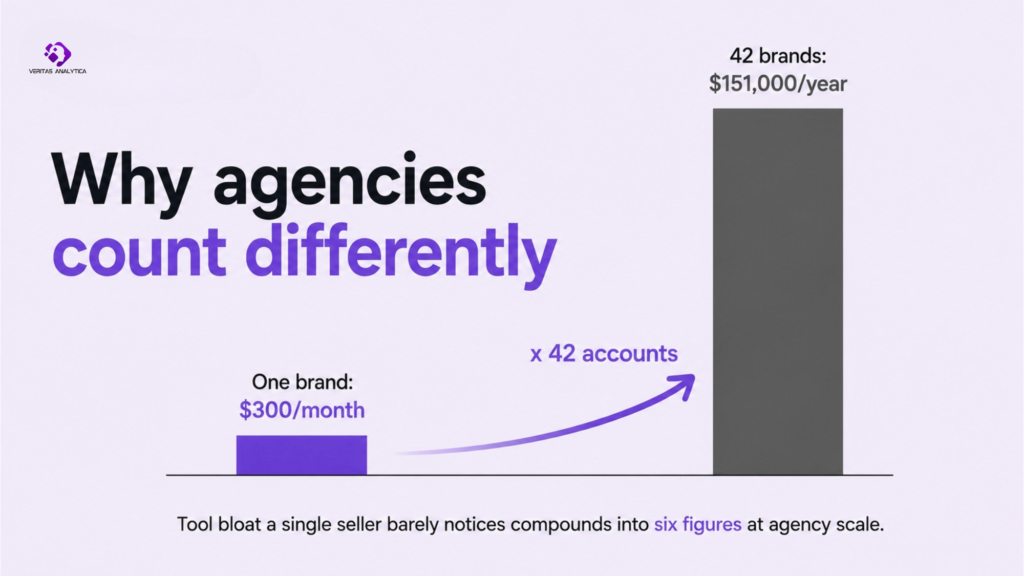
First: what does this cost multiplied by 42? A $300/month tool is a fine expense for one brand. Across 42 accounts it’s $151,000 a year. Tool bloat that a single seller barely notices compounds into six figures at agency scale.
Second: what breaks if this tool fails? A flaky tool is an annoyance for one brand. Across 42 brands it’s an operational fire on every account at once. Agencies avoid newer, less-proven tools even when the features look good, because reliability beats innovation when the blast radius is this big.
Those two questions produce selection rules that look strange from the outside:
- API quality over interface quality. Every tool has to feed its data into the agency’s own reporting system. A tool without a good API gets rejected no matter how nice the dashboard is.
- Bulk operations are a hard filter. If a tool can’t apply a setting across hundreds of ASINs in one action, it’s out. Clicking through 200 listings one at a time doesn’t scale.
- Per-account pricing is the enemy. Any tool that charges per seat or per account gets scrutinized hard, because that cost multiplies by 42.
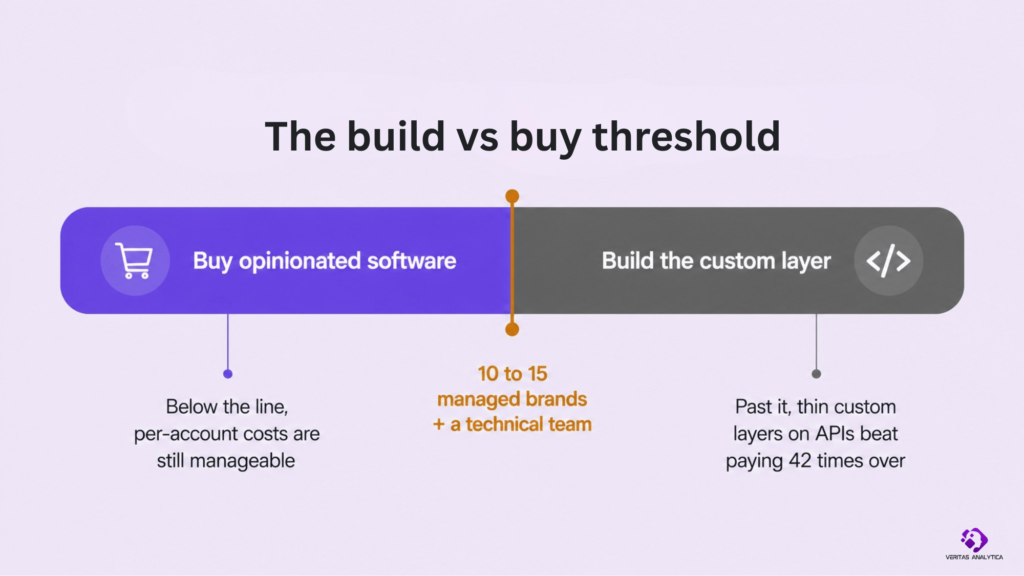
- Build beats buy past a certain point. For reporting, alerting, and consolidated views, a thin custom layer built on top of tool APIs is often cheaper than paying for opinionated software 42 times over.
The 5 External Tools $30M Amazon Agencies Actually Use (2026 Pricing)
Here’s the composite external stack, with what each tool actually costs right now.
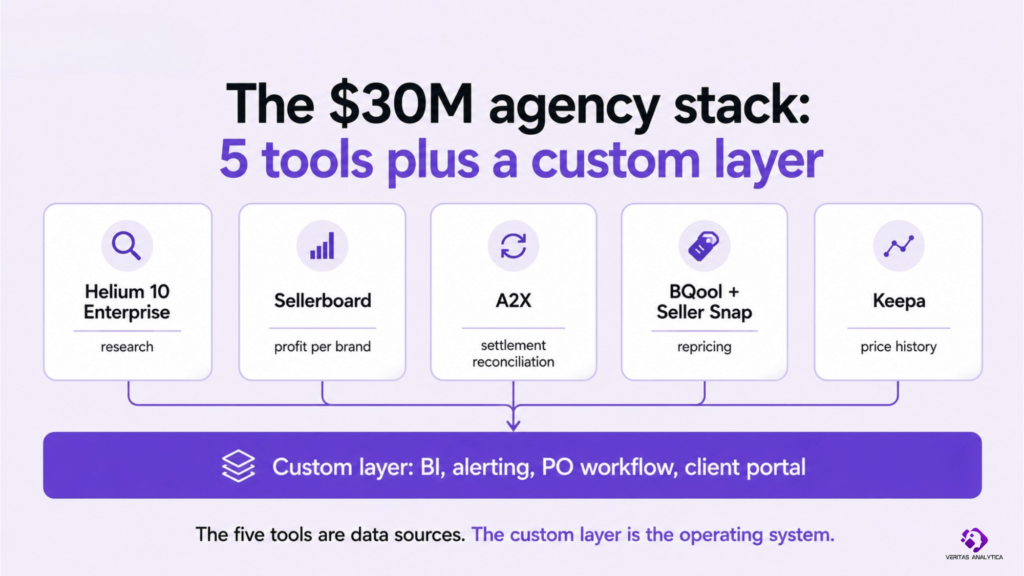
1. Helium 10 Enterprise: The Research and Listing Foundation (From ~$1,499/Month).
Research, listing optimization, reverse-ASIN lookups, and keyword tracking across all brands One important update if you last checked pricing a while ago: Helium 10 restructured its plans in 2026. The old “Supercharge Your Brand” tier is gone, the entry-level Starter plan was retired, and the agency tier is now called Enterprise, starting around $1,499/month with custom pricing above that. Platinum and Diamond also went up, to $129 and $359 monthly. If a tool guide still quotes the old tiers, it hasn’t been updated.
2. Sellerboard: Per-Brand Profit Tracking at the Account Level ($19–$79/Month Each)
Profit visibility, inventory signals, and return tracking per brand. Sellerboard’s pricing scales by order volume, and at the per-brand level it stays cheap enough to multiply across a client roster without pain. This is exactly the linear-cost logic from the section above: a tool that costs $39 per account is one of the few that survives being multiplied by 42.
3. A2X: Accounting Automation Per Client Entity (From $29/Month to ~$229/Month)
Automated Amazon settlement reconciliation into Xero or QuickBooks for every client entity. Amazon pays in lump sums every 14 days, net of fees, and A2X splits those deposits into clean journal entries so every client’s books match the bank. At agency scale this isn’t optional. Nobody is manually reconciling 42 sets of settlements.
4. The Two-Tier Repricer Setup: Why Agencies Use BQool and Seller Snap Together
BQool starts at $25/month with AI tiers from $50, scaling by listing count, and handles standard-complexity brands. Seller Snap is quote-based; 2026 sources report entry pricing anywhere from about $100 to $250/month on annual billing, climbing past $500 at enterprise volume. Its game-theory repricing is worth that only on the highest-volume brands in aggressive categories. So the agency doesn’t pick one repricer. It matches the repricer to the brand, and pays for the expensive one only where the sophistication earns its cost. Worth noting: this whole tool exists because of the wholesale and reseller clients in the mix. Repricers matter when you’re competing for a shared Buy Box, which private label brands mostly aren’t.
5. Keepa: The Non-Negotiable Data Layer (~€19/Month)
Price history and sales estimate cross-checks for sourcing decisions. Cheap, reliable, and its data feeds cleanly into other systems. The kind of tool that never gets cut in a stack audit.
Add it up and the external software bill for a $30M operation is smaller than many $2M sellers’ stacks on a per-brand basis. That’s the point. The mix also shifts with the client book: an agency managing only private label brands could likely drop the repricer tier and run on four tools, while a wholesale-heavy roster would lean on it hardest.
What $30M Amazon Agencies Build In-House Instead of Buying
The five tools above are data sources. The real operating system is custom, and it’s usually four things:
A central reporting layer. Custom BI pulling from Amazon’s SP-API, the Helium 10 API, and Sellerboard exports. It rolls up cross-brand and per-brand reporting automatically, which no off-the-shelf tool does well for 42 accounts.
An alerting system. Triggers for stockout risk, Buy Box loss, negative profit days, and PPC budget exhaustion, wired into Slack channels per account. Instead of someone checking 42 dashboards every morning, the problems come to the team.
Purchase order management. A structured workflow in Notion and Google Sheets, connected to supplier emails and approval chains. Not glamorous, but flexible and free.
A client reporting portal. Brands see their own rolled-up numbers without logging into five different tools. This one is as much a sales asset as an operations one.
The mental model behind all of this: tools are a way to access data and automate actions. Once you’re at scale, a thin custom layer built on top of good APIs usually beats paying for opinionated software, especially for reporting, alerting, and consolidated views.
What $30M Amazon Agencies Deliberately Skip and The Math Behind It
The absences say more than the tools.
Why Agencies Skip PPC Automation Platforms Like Pacvue and Perpetua
This surprises people most, so here’s the math. Perpetua’s base plan is reported at $695/month in 2026, and once a brand passes $10,000 in monthly ad spend it adds a percentage-of-spend fee on top. Pacvue doesn’t publish pricing at all; third-party estimates put it at around $500/month up to roughly 3 percent of monthly ad spend, which works out to about $1,500/month for a single brand spending $50K on ads. Multiply either model across 42 accounts and the platform fees run well into six figures a year. At that scale, in-house PPC specialists working directly in Seller Central with bulk file uploads cost less and keep full control. The tools aren’t bad. The math just stops working when you multiply it.
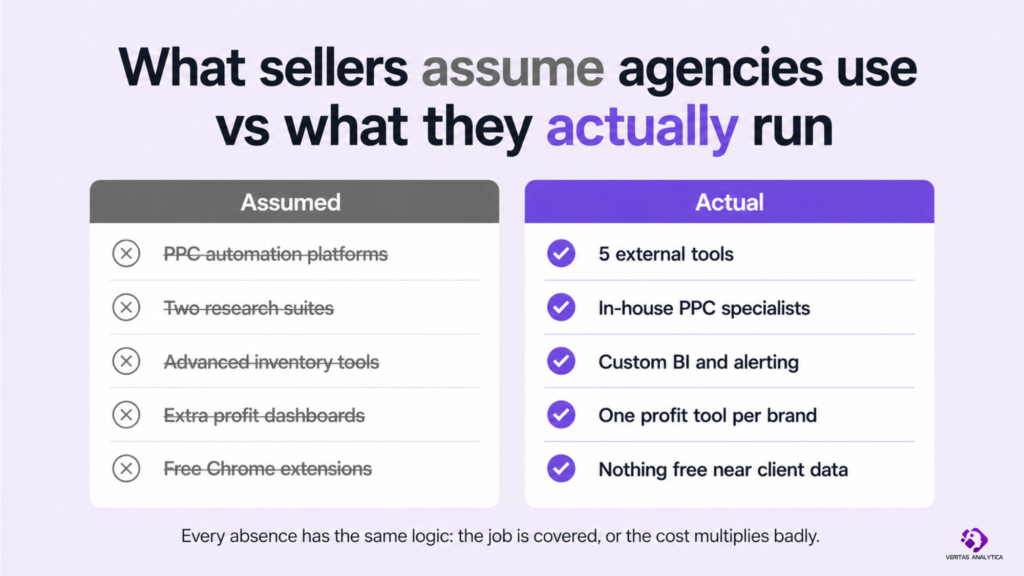
Why Jungle Scout Doesn’t Make the Cut at Agency Scale
Helium 10’s coverage is sufficient, and maintaining two research suites across every account is pure duplication.
Why Agencies Build Inventory Logic Instead of Buying SoStocked or RestockPro
The custom alerting layer replaced them, because off-the-shelf inventory tools don’t handle multi-brand context well.
Why a Second Profit Tool Is Redundant When Sellerboard Is Configured Correctly
ManageByStats, Sellerise, and similar tools are redundant when Sellerboard plus custom BI already covers profit visibility.
Why Free Chrome Extensions Are Removed from Agency Workflows
Data privacy and reliability concerns rule them out when you’re handling client data across 42 accounts.
Every absence follows the same rule: if a tool’s job is already covered, or its cost multiplies badly, it gets cut. Scale doesn’t mean more tools. It means fewer tools plus the custom layer that ties them together.
Where the 5-Tool Agency Model Breaks Down and What Has to Change
Now the honest counterweight, because this stack is not the right answer for most operations.
The whole model depends on one thing: engineering capacity. The custom BI, the alerting system, the client portal all need someone to build them and, more importantly, someone to maintain them. APIs change. Amazon’s SP-API updates break integrations. Reports drift out of date. A custom layer without a maintainer becomes technical debt with a dashboard on top.
An agency or seller without at least one dedicated technical person is better off paying for opinionated software, even at multiplied cost. A $500/month tool that works is cheaper than a free custom script that silently breaks during Q4.
There’s also a scale floor. Below roughly 10 to 15 managed brands, the per-account cost of off-the-shelf tools is still manageable, and the build effort doesn’t pay back. The build-vs-buy line is a complexity threshold, the same logic we covered in our guide on when a seller actually needs an ERP. Under the threshold, buy. Past it, the math flips.
And one more limit: this stack assumes reselling and brand management, not manufacturing. An operation with real bill-of-materials complexity needs systems this lean stack doesn’t cover.
How to Apply This Model If You’re Scaling an Amazon Business Toward Agency Complexity
If you’re an individual seller heading toward multi-brand or agency-level operations, three lessons transfer down:
Choose Tools by API Quality Before You Need to Integrate Them
The tool that exports cleanly today is the tool you can build on in two years. The tool with a beautiful dashboard and no API is a dead end you’ll pay to migrate away from.
Start Building Your Custom Reporting Layer Before You Think You Need It
Building basic consolidated reporting at $5M in revenue is far cheaper than retrofitting it at $15M, when your data lives in six tools that were never chosen with integration in mind.
Run a Tool Redundancy Audit the Way Amazon Agencies Do
Ask of every tool: is its job already covered by something else I pay for? At agency scale that question saves six figures. At your scale it probably saves a few thousand a year, and the habit compounds.
The stack that runs $30M isn’t impressive because of what’s in it. It’s impressive because of what was cut.
Frequently Asked Questions
What Tools Do $30M Amazon Agencies Actually Use to Manage Operations?
Leaner stacks than most sellers expect. A typical large agency runs a research suite (commonly Helium 10 Enterprise), per-brand profit tracking (commonly Sellerboard), settlement reconciliation (A2X), one or two repricers matched to brand complexity (BQool, Seller Snap), and a price-history tool (Keepa). Reporting, alerting, and client dashboards are usually custom-built on top of tool APIs.
How much does Helium 10 Enterprise cost in 2026?
Helium 10 Enterprise starts at about $1,499/month with custom pricing above that, billed annually. It replaced the old “Supercharge Your Brand” tier after Helium 10 restructured its plans in 2026. The restructure also retired the entry-level Starter plan and raised Platinum to $129/month and Diamond to $359/month on monthly billing.
Do Amazon Agencies Use PPC Automation Tools Like Pacvue or Perpetua?
When three things are true: you manage enough accounts or brands that per-account tool costs multiply badly, you have at least one technical person to build and maintain the custom layer, and the job you’re solving is reporting, alerting, or consolidation rather than a specialized function. Below that threshold, buying opinionated software is cheaper and safer than building.
At What Point Should an Amazon Seller Build Custom Tools Instead of Buying Off-the-Shelf?
Many large agencies don’t. Perpetua’s base plan is reported at $695/month in 2026, plus a percentage of ad spend above $10K/month. Pacvue doesn’t publish pricing; third-party estimates run from about $500/month up to roughly 3 percent of ad spend. Multiplied across dozens of accounts, those fees often exceed the lift the tools provide, so agencies run PPC with in-house specialists using Seller Central and bulk file uploads instead.