
Every Amazon seller group runs the same question on a loop: “Keepa, CamelCamelCamel, or Helium 10? Which one should I get?” It’s the wrong question. And the typical response is a feature comparison chart that ends with one tool being declared the best, leading folks to invest in something they might never really use for their business.
So here’s the part those comparison posts leave out. These three tools aren’t competing with each other. Two of them are built for sellers who resell products that already exist. The third is built for sellers who create their own. That’s why this blog doesn’t pick a clear winner. Instead, it helps you figure out which tool aligns with your actual business model and which one would just be a waste of your hard-earned money.
The Short Answer: Which Tool Is Right for Your Amazon Business Model?
If you do retail arbitrage, online arbitrage, or wholesale, where you resell products that already exist, you want Keepa. Camel, Camel, Camel is worth keeping around as a free starting point but not as your main tool.
If you run a private label, where you create and launch your own products, the tool you’re really comparing is Helium 10 Xray, and its closest rival is Jungle Scout rather than Keepa.
If you’re a shopper or deal hunter rather than a seller, CamelCamelCamel does everything you need, for free.
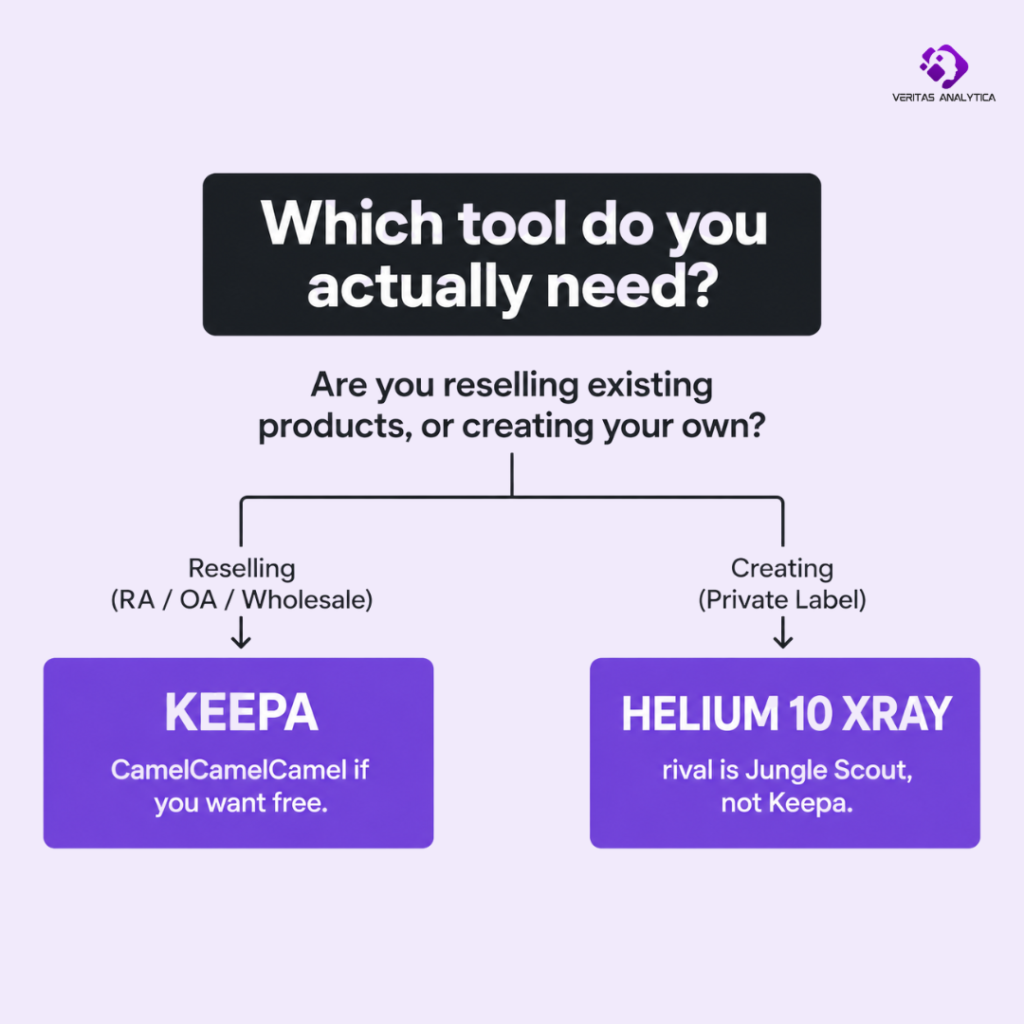
Why Keepa, CamelCamelCamel, and Helium 10 Xray Are Not Actually Competing Tools
Open any of the three tools for a product, and you’ll find a chart that takes you back in time, making them seem pretty similar at first glance. But they’re actually quite different because each one answers a different question.
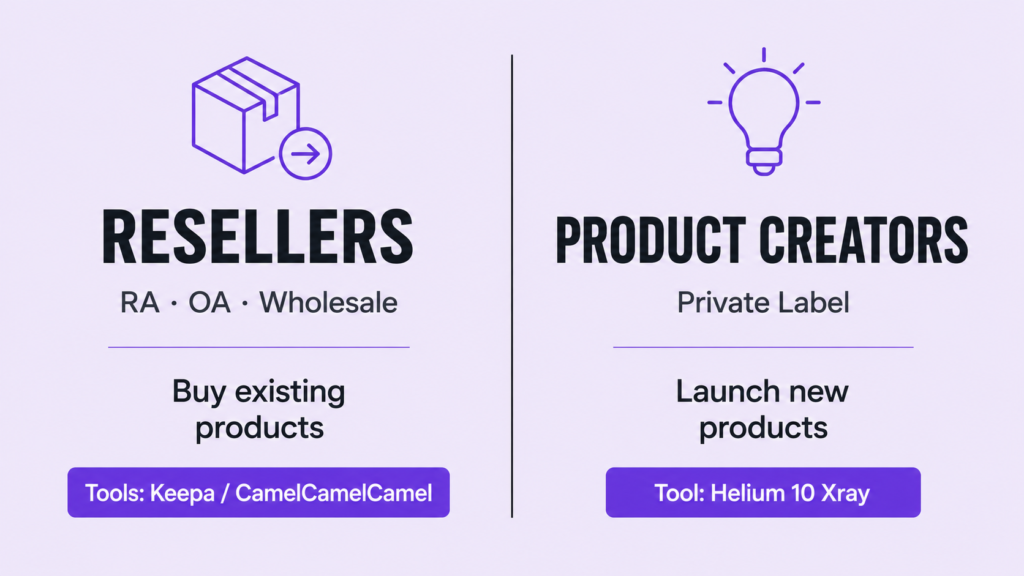
Keepa and CamelCamelCamel focus on a buying question: if I buy this to resell, will it actually sell, and will the price remain stable? This is the realm of resellers. In retail arbitrage (RA), online arbitrage (OA), and wholesale, you’re evaluating one ASIN at a time based on two key factors: whether it’s been selling, which is what the sales-rank history reveals, and whether the price is consistent, which is shown by the price history.
On the other hand, Helium 10 Xray addresses a burning question: Should I even consider launching a product like this? This is the private-label space, where there’s no existing track record to look up because the product hasn’t been created yet. Here, the focus isn’t on sourcing a deal; it’s about validating a market before you decide to place an order with a manufacturer.
So, while they all operate in the same marketplace, they’re asking completely different questions. That one distinction makes all the difference in the comparison.
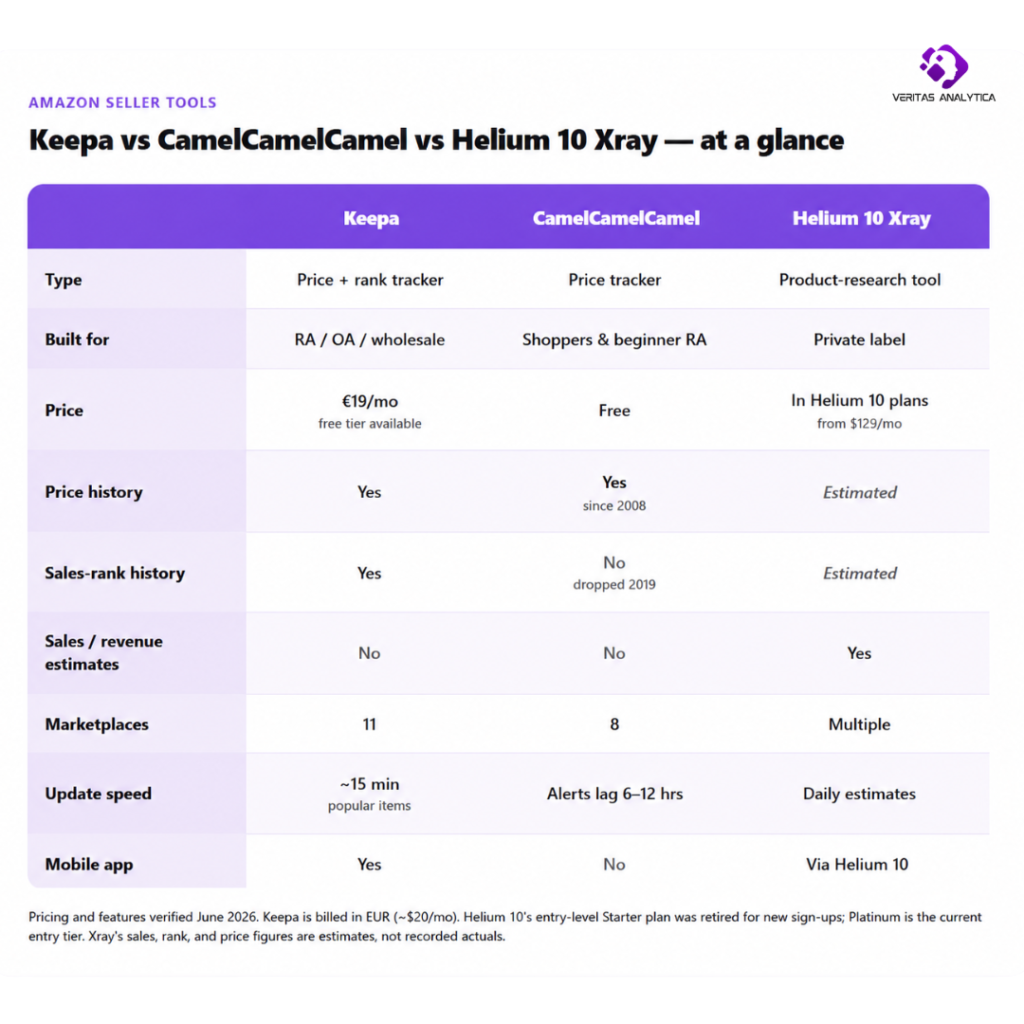
Keepa vs CamelCamelCamel vs Helium 10 Xray: Side-by-Side at a Glance
Keepa: Why It’s the Depth Standard for Amazon Resellers and Wholesale Sellers
When it comes to retail arbitrage, online arbitrage, and wholesale, Keepa is pretty much the go-to tool in the industry. Its sales-rank history is the best proxy you’ll find for how frequently a product actually sells: if you see a rank dropping sharply and consistently, that means units are moving. Read that alongside the price line and you’ve got your answer. A good rank with a flat price is a buy. A good rank with a sliding price is a price war you want to stay out of.
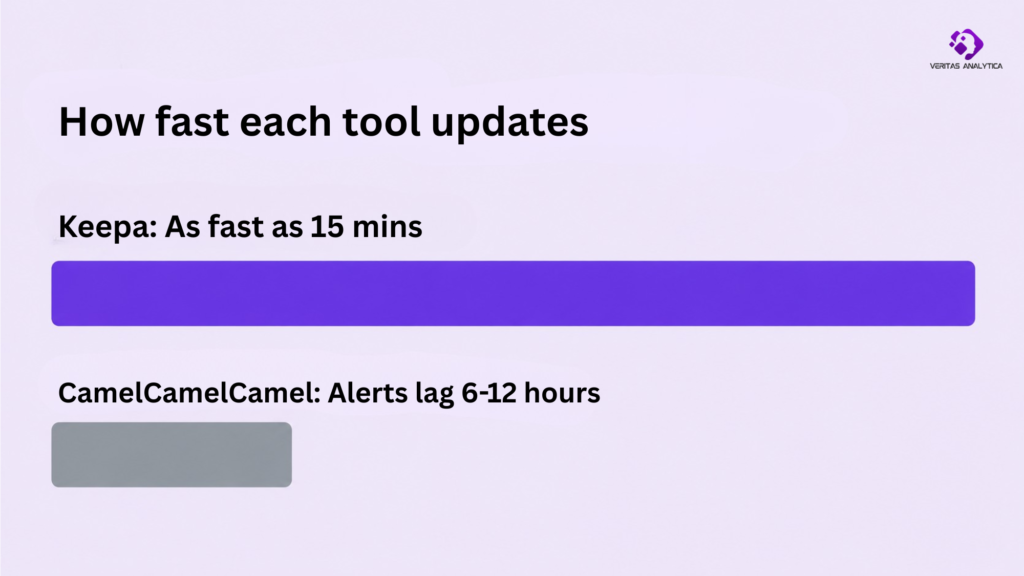
One of the reasons why Keepa stands out is its speed. Amazon updates its catalog millions of times each day, and Keepa refreshes as frequently as every 15 minutes for popular items. This quick turnaround can mean the difference between catching a price drop right as it happens or realizing it a week later. The pricing is straightforward too: just one flat plan at €19 per month, plus a free tier for those who want to dip their toes in.
The honest catch is the learning curve. The graph is dense and takes time to read fluently, and there’s a quota system that throttles you if you’re pulling data on hundreds of ASINs a day.
CamelCamelCamel: The Free Amazon Price Tracker and Where It Falls Short
Almost every arbitrage seller kicks things off with CamelCamelCamel (CCC) because, well, it’s free! It provides a clear price-history chart for Amazon, along with third-party new and used items, plus handy drop alerts. Plus, it’s been tracking prices since 2008, which gives you a solid enough timeline to catch seasonal trends that many other tools might miss.
Here’s the catch most comparison posts skip. CamelCamelCamel stopped tracking sales-rank history in February 2019 and never brought it back. Open the sales-rank tab today, and you’ll find a notice saying it’s disabled with no plans to return. That matters more than it sounds, because price and rank tell you two different things. Price history tells you what something cost. Sales rank tells you whether it sold. Without rank, you can see that a price held at $24.99 for six months, but you have no idea whether the product moved ten units or ten thousand. For a sourcing decision, that’s half the picture gone.
So in 2026, CCC really serves two people: shoppers hunting deals and brand-new sellers who haven’t paid for Keepa yet. It’s a fine on-ramp. It just isn’t a tool to make real inventory bets on by itself.
Helium 10 Xray: What It’s Actually Built For (And Who Should Be Using It)
Xray isn’t a price tracker at all. It’s a product research overlay built for private labels. Run it on any Amazon search, and it estimates each competitor’s monthly sales and revenue, along with BSR, reviews, price, and seller count, so a PL seller can size up a niche before committing to it.
The distinction that matters is simple: Xray gives you estimates, not actuals. Keepa records what the price genuinely was. Xray models what sales probably were. Helium 10’s own study puts those estimates within roughly 10% of real sales, which is worth treating as the vendor’s claim rather than an independent fact. That accuracy is fine for validating a launch. It isn’t good enough to base an arbitrage buy on, which is exactly why resellers don’t reach for it.
On price, Xray comes bundled inside the Helium 10 suite rather than sold on its own. After the April 2026 increase, Platinum runs $129/mo (about $99 a month billed annually) and Diamond $359/mo (about $279 annually), and the entry-level Starter plan was retired for new sign-ups. You’re buying a research suite, not a €19 tracker, and its natural comparison is Jungle Scout, not Keepa.
Just Want to Check a Product’s Price History on Amazon? Start Here
If all you need is a quick price history, CamelCamelCamel (free) or Keepa will both do it.
For seasonal patterns going back years, CamelCamelCamel’s record since 2008 runs deepest.
To know whether something is selling right now, Keepa is the only real option. CCC can’t show it anymore, and Xray only estimates.
To size up a whole niche, that’s Xray’s job.
The Two Most Common Mistakes Amazon Sellers Make When Choosing These Tools
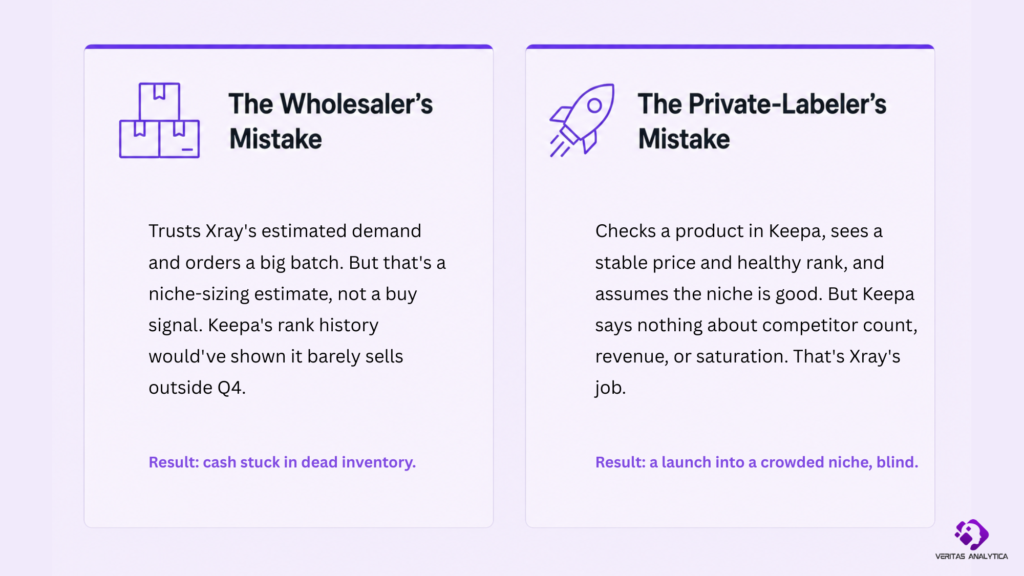
The Wholesale Seller’s Mistake: Using Helium 10 Xray When You Need Keepa
A wholesale seller checks a potential buy in Xray, sees an estimated 800 units a month, and orders 500. The problem is that the 800 figure is a niche-sizing estimate, not a buy signal for that specific ASIN. Keepa’s rank history would have shown the product barely moves outside Q4. The result is cash tied up in inventory that won’t sell.
The Private Label Seller’s Mistake: Relying on Keepa for Product Research
A private-label seller checks a product in Keepa, sees a stable price and a healthy rank, and assumes the niche is worth entering. But Keepa says nothing about competitor count, revenue, or saturation, and that’s the whole reason Xray exists. The result is a launch into a crowded niche with no idea it was crowded.
Same marketplace, opposite mistakes, and both come from reaching for the tool built for the other kind of business.
The Verdict: Which Tool to Use Based on How You Sell on Amazon
There’s no clear winner in this scenario because these tools aren’t really competing in the same league. Keepa is the go-to for resellers, setting the standard when it comes to depth. If you’re into retail arbitrage, online arbitrage, or wholesale, that €19 investment is totally worth it.
On the other hand, CamelCamelCamel is a handy free price-watching tool. It’s great for shoppers and newcomers, but keep in mind that CCC dropped sales-rank tracking in 2019, and the feature is gone from the site entirely, so don’t rely on it solely for your inventory decisions.
Then there’s Helium 10 Xray, which is designed as a private-label research suite, serving a different purpose altogether. Ultimately, it all comes down to your business model. Figure out if you’re reselling or creating, and the choice will become a lot clearer.
Frequently Asked Questions
Is CamelCamelCamel still worth using in 2026, or has Keepa replaced it?
For shoppers and new arbitrage sellers, yes. It’s free, and its price history goes back to 2008. Just remember it dropped sales-rank tracking in 2019, so it can’t tell you whether a product actually sells. Once you’re sourcing for real, move to Keepa.
Can I use Helium 10 Xray for arbitrage and wholesale instead of Keepa?
You can see some history in Xray, but it’s estimate-based and built for private-label research, not per-ASIN buying decisions. For arbitrage and wholesale, Keepa does the job better and at a fraction of the cost.
What’s the best free Amazon price tracker?
CamelCamelCamel, for price history and alerts. Keepa’s free tier gives you more data but comes with a steeper learning curve.
Which Is More Accurate for Amazon Price History: Keepa or CamelCamelCamel?
Both pull from Amazon, but Keepa updates far more often, around every 15 minutes on popular items versus CCC’s slower cadence, and it tracks more data points. That makes it the more reliable of the two for sellers.