Most Amazon private label tool stacks are wrong, and the cost shows up six months later. A founder paying $47,000 for inventory that will not move because the tool stack never gave him the data to source it correctly in the first place. Even if the product was usually fine. The tool stack did not catch the warning signs.
The right tool at the wrong stage drains the margin just as fast as the wrong tool. Most Amazon private label tool guides will not tell you this because they earn affiliate commissions from every link. This guide is different. It maps the verified 2026 private label tool stack, phase by phase, from pre-launch through $100K+ months.
What to use. What to keep. What to skip.
What you’ll find in this guide
- Phase 1 – Pre-launch (pre-revenue)
- Phase 2 – $0 to $5,000/month
- Phase 3 – $5,000 to $30,000/month
- Phase 4 – $30,000 to $100,000/month
- Phase 5 – $100,000+/month
- The tool stack at a glance
- Free Amazon-native tools worth using at every phase
- Six mistakes private label sellers make with their tool stack
- Frequently asked questions
Why Amazon Private Label Needs Its Own Tool Stack
Private label runs on four activities, each with its own tool category:
- Research the product opportunity and validate demand before committing to a supplier
- Build a keyword-optimized listing that indexes, ranks, and converts
- Launch with paid traffic and protect margin while transitioning from paid to organic
- Track true profitability per SKU as the catalogue and costs grow
The private label is PPC-heavy from the first launch and listing-optimization-heavy at every stage. The phases below connect the tools to the revenue stage, where they start to pay off, and flag the ones the industry often pushes you to buy too early.
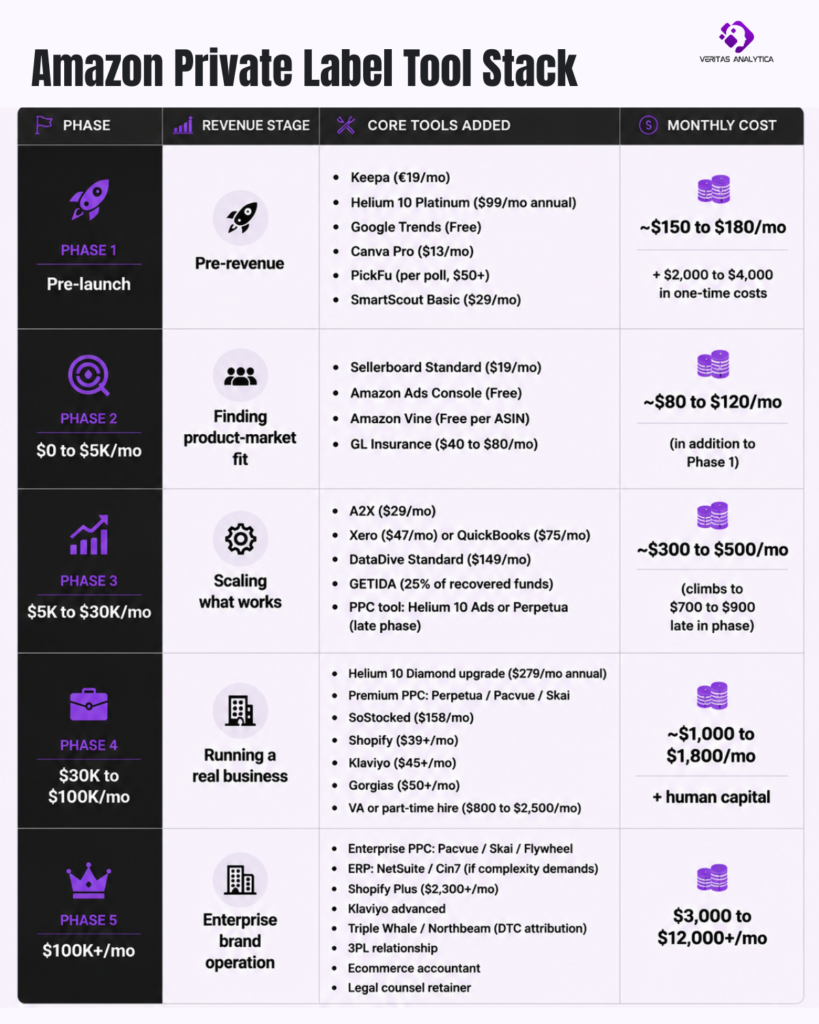
Phase 1 – Pre-launch: ~$150 to $180/month + $2,000 to $4,000 in one-time launch costs
Monthly subscriptions: Keepa + Helium 10 Platinum + Google Trends + Canva Pro + PickFu + SmartScout Basic
Before your first product goes live, the job is validation, not execution. Helium 10 Platinum ($99/month annual, $129 monthly) covers product discovery, keyword research, and live opportunity data. Helium 10 retired its Starter plan in January 2026, so Platinum is now the entry point. Keepa (19 euros/month) shows 24 months of BSR and price history, telling you whether a niche is seasonal, declining, or stable.
Google Trends (free) validates demand direction. Canva Pro ($13/month) handles hero images. PickFu (from $50 per poll) split-tests your main image against a real consumer panel before launch.
SmartScout Basic ($29/month) earns its place here for sellers serious about category and niche selection. It surfaces subcategory revenue data, brand-level market share, and ASIN portfolios per seller, the intelligence that closes the gap between “this category looks interesting” and “I understand exactly who I would be competing against.”
Two free utilities round out Phase 1: Alibaba RFQ for supplier discovery and Freightos for freight quotes. Both are free to use and pay only on actual shipments.
One-time launch costs
- Trademark filing: USPTO direct (~$350) or LegalZoom (~$600). Start now because of the 8-12 month registration timeline. Amazon IP Accelerator (~$1,500) is the fast alternative.
- Product photography: $500 to $2,000 for a launch shoot. Quality images are the single biggest CTR lever on Amazon.
- Inspection service: QIMA or Asia Inspection ($150 to $300 per inspection). One inspection before shipping saves more than the cost on any meaningful order.
Skip Helium 10 Diamond, DataDive, PPC automation, and any inventory system. None solve a problem you have yet.
Phase 2 – $0 to $5,000/month: ~$80 to $120/month
Add: Sellerboard Standard + Amazon Ads Console + Amazon Vine + SmartScout Basic (optional) + GL Insurance
You have launched. This is the most tool-tempting phase: resist most of it. Add Sellerboard Standard ($19/month, $15 annual) to track per-unit COGS and FBA inventory from day one. Sellerboard includes bundled review automation, so no separate review tool is needed. It scales through Phase 3 with no migration.
Run PPC on Amazon’s native Advertising Console (free). Your spend is not yet large enough to justify automation, and manual management teaches the fundamentals you will need to diagnose campaigns later. Enroll new ASINs in Amazon Vine to accelerate the first 30 reviews.
SmartScout Basic carries forward from your Phase 1 stack. No upgrade needed yet, the Basic tier continues to deliver category and competitor intelligence at this revenue level.
Commercial GL insurance ($40 to $80/month for $1M coverage from Next Insurance or Hiscox) is required by Amazon once you hit $10K/month for three consecutive months. Set up early. Account suspension while you scramble for insurance is avoidable.
A Google Sheet handles inventory tracking for 1-3 SKUs. Dedicated inventory software is overkill until 5+ SKUs or strong seasonality.
Skip PPC automation, Shopify, and help desk tools until ticket volume demands it.
Phase 3 – $5,000 to $30,000/month: ~$300 to $500/month
Add: A2X + Accounting + DataDive + GETIDA + PPC Automation (late in phase)
You have proven the product works. Manual processes that worked at $5K break at $20K. Add A2X ($29/month) with Xero ($47/month) or QuickBooks ($75/month). This pair replaces the spreadsheet P&L and prevents COGS errors that compound across the tax year.
DataDive Standard ($149/month) surfaces the long-tail keyword universe Cerebro’s relevance filter removes. Sign up for GETIDA (25% of recovered funds, first $400 free) to recover the FBA reimbursements Amazon owes you.
PPC automation is the most over-recommended tool in the ecosystem. The threshold is $5,000/month in ad spend, not revenue. Stay on the native Console until ad spend crosses $5K, typically at $20K-$30K/month in revenue. When you cross it, Helium 10 Ads or Perpetua ($695/month for up to $10K ad spend) are the strong options.
Costs climb to $700-$900/month late in the phase as PPC automation and DataDive come online. Defer SoStocked to Phase 4. A spreadsheet handles 1-5 SKUs.
Skip Shopify, enterprise analytics, and more than one PPC tool. Pick one and master it.
Phase 4 – $30,000 to $100,000/month: ~$1,000 to $1,800/month
Add: Helium 10 Diamond + Premium PPC + SoStocked + Shopify + Klaviyo + Gorgias
You are a real business now. The question shifts from “is this worth it?” to “what is the cost of not having this?” Upgrade to Helium 10 Diamond ($279/month annual, $359 monthly) for multi-user access and expanded limits, now in genuine daily use.
Upgrade PPC to Perpetua, Pacvue, or Skai. At $10K-$30K/month ad spend, a 5-10% efficiency gain pays the tool back many times over. SoStocked ($158/month) now earns its price: a stockout costs more in lost BSR than a year of the tool. For competitor monitoring, manual checks via Helium 10 Xray and Keepa (30 minutes/week) cover what a single-brand operator needs. Stackline and Profitero are built for $5M+ brands, not this phase.
Shopify ($39-$399/month) finally earns its place once you have an email list and brand demand. Klaviyo ($45+/month) turns that list into a marketing channel. Gorgias or Helpscout ($40-$300/month) handles customer service volume.
Time becomes the binding constraint at this revenue. A virtual assistant or part-time hire ($800-$2,500/month) typically delivers better ROI than additional tools.
Skip a full ERP unless you genuinely have multi-channel, multi-warehouse, or multi-entity complexity.
Phase 5 – $100,000+/month: $3,000 to $12,000+/month
Add: Enterprise PPC + ERP (if complexity demands) + Shopify Plus + DTC Attribution + Operational Layers
Tools should now be enterprise-grade and serve as competitive moats. Pacvue, Skai, or Flywheel ($2,500-$10,000+/month) manage PPC across multiple retailers from one interface. An ERP (NetSuite or Cin7 Omni) is worth its painful implementation only when complexity exists across at least three dimensions: multi-channel, multi-warehouse, and multi-entity. Most brands at this revenue have one or two, not three.
Shopify Plus ($2,300+/month) is required if DTC is serious at this scale, with Klaviyo at full tier for email and SMS. Triple Whale or Northbeam ($1,500-$5,000/month) provides the multi-touch attribution you need once Meta and TikTok drive traffic to Shopify.
Three operational layers earn their place beyond the tool stack: a 3PL relationship ($3-$5/unit), an e-commerce specialized accounting firm ($500-$2,000/month), and legal counsel on retainer ($300-$800/month) for IP enforcement, Brand Registry takedowns, and hijacker removal.
The pattern at this scale is counter-intuitive: the best-run eight-figure brands often run fewer external tools than $500K sellers, replacing aggregator dashboards with custom data queries against raw Amazon data.
Free Amazon-Native Tools Worth Using at Every Phase
Most paid tool guides skip Amazon’s free native tools because there is no commission to earn on features Amazon already built into Seller Central. These four are genuinely high-leverage and underused:
| Brand Analytics: Top Search Terms dashboard shows the keywords customers actually use to find your products and the top three ASINs winning each one, with click and conversion share data. Available to Brand Registered sellers. The closest free equivalent to Cerebro for understanding the live competitive landscape on a query. |
| Search Query Performance: Lives inside Brand Analytics under Search Analytics. Shows your brand’s impressions, clicks, cart adds, and purchases broken down by search term, with market median pricing and shipping speed signals. This is first-party Amazon data on search volume and your share of it that no paid tool can replicate. |
| Manage Your Experiments: Free native A/B testing for titles, main images, and A+ content. Requires Brand Registry and sufficient traffic to run statistically valid tests. Replaces paid split-testing at most phases. |
| Amazon Posts: Organic visual content that surfaces in your storefront, on your product detail pages, and in category feeds. Free to publish, and underused. Treat it like organic social, not advertising. |
Use these alongside the paid stack at every phase. They do not replace paid tools but they cover ground that no third-party tool reaches.
Six Mistakes Private Label Sellers Make With Their Tool Stack
Mistake 1: Buying Helium 10 Diamond before $15K to $25K per month
Diamond at $279/month annual is $3,348 per year. Platinum at $99/month annual is $1,188 per year. The $2,160 annual difference buys multi-user access, expanded keyword tracking, and PPC automation that most sub-$25K sellers do not actively use. Unless you are running a team and meaningful ad spend, you are paying for unused capacity. Helium 10’s 2026 price increase makes this mistake more expensive than it used to be.
Mistake 2: Paying for PPC automation before $5K per month in ad spend (not revenue)
The threshold that matters is $5,000/month in ad spend, not revenue. Most sellers cross that level somewhere between $20K and $30K/month in revenue. Below the ad spend threshold, Amazon’s native Advertising Console delivers results as good as paid automation, and it teaches you the fundamentals. Most PPC tools start at $250 to $695 per month. Sellers who automate before building manual PPC intuition cannot diagnose campaigns when they underperform, which costs more than the subscription itself.
Mistake 3: Skipping Sellerboard until $30K per month
Sellerboard costs $19/month and recovers more than that through FBA reimbursement tracking alone for most sellers. Flying blind on profit until $30K/month means making 12 to 18 months of pricing, sourcing, and PPC decisions without accurate margin data. The revenue cost of bad decisions in that window typically dwarfs the entire annual tool cost. Sellerboard’s bundled review automation also removes the need for a separate review tool, simplifying the Phase 2 stack.
Mistake 4: Using Cerebro alone for launch keyword research
Helium 10 Cerebro covers most keywords, but its relevance filter systematically discards long-tail phrases with lower individual volume and higher buyer intent. At launch preparation, DataDive’s niche Dive surfaces that hidden keyword universe. For competitive categories, the keywords Cerebro filters out are often exactly where the conversion efficiency lives. Treating Cerebro’s output as the complete picture leaves ranking and PPC efficiency on the table.
Mistake 5: Adding Shopify before you have a reason to be off Amazon
Building a DTC store before you have an email list, brand demand, or a product line that benefits from a direct channel means paying for a site that gets no traffic. The right sequence is to dominate Amazon first, capture demand through inserts and brand registry, then build the direct channel at Phase 4 once there is demand to capture. Shopify built too early is a monthly cost with no return.
Mistake 6: Buying an ERP at $2M revenue before complexity demands it
ERP vendors market aggressively to sellers crossing $2M per year. But a single-warehouse, Amazon-only, single-entity business does not need a $1,000 to $5,000/month ERP no matter its revenue. The real threshold is genuine complexity across three or more dimensions: multi-channel, multi-warehouse, multi-entity. Buying an ERP because revenue crossed a number rather than because complexity demanded it means using 20% of the features and paying 100% of the price.
The Bottom Line with Amazon Private Label Tool Stack
Every tool has its own threshold. Invest in them only after you have reached that point, not before. The private label operators who build the most effective tool stacks are not the ones with the largest number of subscriptions. They are the ones who thoughtfully matched each tool to a specific challenge in the business at the right moment, and tuned out the noise until it became necessary.
Diving deep into five tools will always beat skimming the surface of twenty. The real competitive advantage is not the size of your stack. It is the discipline to focus on the few tools that genuinely move the needle, and to master them.
Frequently Asked Questions
What tools do I need to start a private label Amazon business in 2026?
At pre-launch you need Keepa (19 euros per month) for demand and price history, Helium 10 Platinum ($99 per month on annual billing) for product research, keyword research, and listing tools, plus free tools like Google Trends. Add Canva Pro ($13 per month) for listing images, PickFu (from $50 per poll) to split-test your main image before launch, and SmartScout Basic ($29 per month) for category and niche selection intelligence. Total: roughly $150 to $180 per month in subscriptions, plus $2,000 to $4,000 in one-time launch costs for trademark, photography, and inspection. Avoid Helium 10 Diamond, DataDive, and any PPC automation until you have revenue.
Is Helium 10 Diamond worth it for private label sellers?
Only above $15,000 to $25,000 per month in revenue, and only when you are actively using its PPC automation, multiple user logins, or expanded keyword tracking. Helium 10 raised prices in 2026: Platinum is now $99 per month annual ($129 monthly) and Diamond is $279 per month annual ($359 monthly). The $2,160 annual difference between them only pays back when Diamond’s expanded limits are in active daily use. Below that revenue, Platinum covers everything a private label seller needs.
When should a private label seller pay for PPC automation software?
At Phase 3, when you cross roughly $5,000 per month in ad spend. Below that, Amazon’s native Advertising Console is sufficient and teaches you the fundamentals you will need to diagnose campaigns later. Most PPC automation tools start around $250 to $695 per month, so the efficiency gain only justifies the cost once your ad spend is large enough for a small percentage improvement to exceed the subscription fee. Perpetua starts at $695 per month for up to $10,000 in monthly ad spend.
Do I need DataDive if I already have Helium 10?
Not at launch. Helium 10 Cerebro covers 85% or more of actionable keywords for most private label sellers. DataDive (Standard at $149 per month) earns its place at Phase 3 during serious launch preparation, when its niche Dive surfaces a materially different long-tail keyword universe than Cerebro’s relevance filter returns. For sellers in highly competitive categories where marginal keyword discovery drives real revenue, it is worth adding. For straightforward niches, Cerebro alone is sufficient.
When should a private label seller build a Shopify store?
At Phase 4, $30,000 per month or higher, and only when you have a genuine reason to be off Amazon, an email list to drive there, brand demand, or a product line that benefits from a direct channel. Building a Shopify store before that stage means paying $39 or more per month for a site that gets no traffic. The right sequence is: dominate Amazon first, capture demand, then build the direct channel once there is demand to capture.
What is the best profit tracking tool for private label sellers?
Sellerboard, starting at $19 per month ($15 on annual billing). It tracks per-unit COGS, profit per order, and FBA reimbursements cleanly from Amazon’s API, and scales from Phase 2 through enterprise without migration. Inventory Lab ($69 per month) is a workable alternative if you prefer its interface, but most operators starting fresh in 2024 to 2026 land on Sellerboard for the price and feature combination. Adding it from Phase 2 avoids the friction of switching profit tools as you scale.
About Veritas Analytica
Veritas Analytica is an independent research brand covering Amazon seller tools. We do not sell the tools we cover, take vendor sponsorships, or earn affiliate commissions on any tool recommended in this guide. Our only goal is to recommend what actually works at each stage. All pricing verified May 2026. Confirm current rates on vendor sites before subscribing.