Somewhere in your ad account right now, there’s probably a keyword spending $20 or $30 a day that isn’t indexed anywhere in your listing. Not in the title. Not in the bullets. Not in the backend search terms.
Your PPC tool doesn’t know that. It just sees a keyword that converted once, months ago, and keeps bidding on it. Your listing tools have no idea either, because checking indexing isn’t their job: the content builder writes the copy, and the index checker only reports what you ask it to check, whenever you remember to ask. Nothing in the stack watches ad spend and indexing at the same time, so nothing ever flags the problem.
This matters more in 2026 than it ever has. Across professionally managed accounts, ads now drive a median 41% of total sales on Amazon. That number comes from SellerPlex’s H1 2026 benchmark data covering real managed accounts, and it tells you something uncomfortable: for brands that advertise seriously, Amazon has become a paid-first channel. When nearly half your revenue runs through the ad system, a sync failure between your PPC tool and your listing isn’t a small leak. It’s a hole in the main pipe.
So let’s walk through why the gap exists, what amazon ppc non indexed keywords actually cost you, and the one audit that closes the gap. No tool on the market does it for you. That is part of the story too.
Why Your PPC and Listing Tools Can’t Talk to Each Other
A typical mid-size Amazon stack looks something like this. A PPC tool handles the bidding: Adtomic if you’re on Helium 10 Diamond ($279/month on annual billing, plus 2% of ad spend over $5K), Perpetua (plans start around $250/month and scale with ad spend), or Scale Insights ($69 to $499/month, flat per-ASIN pricing). A listing tool handles the content side: Helium 10’s Listing Builder and Scribbles, or SellerApp. And a keyword research tool feeds both of them: Cerebro or DataDive.
These are three tools. Three separate databases. Three different opinions about the same keyword.
The PPC tool tracks bids, clicks, and conversions. The listing tool tracks what’s written in your title, bullets, and backend fields. The research tool tracks search volume and competitor rankings. None of them checks its recommendations against the others. When they disagree, and they disagree constantly, there’s no alarm. The disagreement just sits there, quietly, in your ad spend.
What Amazon PPC Non-Indexed Keywords Actually Cost You in 2026
First, let’s clear up the objection experienced sellers will raise here: “if the keyword isn’t indexed, Amazon won’t serve the ad at all.” That’s a half-myth. Ad targeting and organic indexing are separate systems. A manual campaign will happily serve on any keyword you target, whether or not that term exists anywhere in the listing. It’s the same reason auto campaigns can surface search terms that aren’t in your copy. So yes, a fully non-indexed keyword can absolutely carry ad spend for months. It just carries it on the worst possible terms.
Here’s the part most sellers underestimate. Bidding on a keyword you’re not indexed for doesn’t just waste the clicks. It changes the economics of every click.
Amazon Ad Relevance Prices Your Clicks, Not Just Bids
Amazon runs a second-price auction, but your bid is only half the equation. Amazon’s own documentation says ad placement weighs bid and relevance together, and when your listing has no connection to the search term, two things happen, and both cost you. Where relevance is very poor, Amazon throttles impressions, so the keyword underdelivers no matter how high you bid. And where the ad does serve, you pay more for worse placement, because a better-matched competitor beats you at a lower bid.
The pricing side of this isn’t something Amazon publishes, but the benchmark data is consistent. 2026 agency data shows brands with well-optimized listing content paying 20 to 35% less per click on the same keywords compared to competitors with thin or misaligned listings. And the baseline keeps rising. The average Amazon CPC hit $1.22 in 2026, up about ten cents from last year and up more than 60% since 2020. Sponsored Display has it even worse, jumping 49% year over year to around $3.72 per click. Add the seasonal squeeze on top: CPCs spike 60 to 80% during Prime Day and Q4. When the base price climbs every year, a 20 to 35% relevance penalty compounds right along with it.
A non-indexed keyword is the worst version of this penalty. You’re telling Amazon’s ad system to sell traffic for a term its own search system doesn’t associate with your product. Amazon takes the money. It just charges you more and places you worse.
Why Is My ACoS So High? The Misdiagnosis Loop
Now look at what this does inside your PPC dashboard. The keyword shows an ACoS of 48%. For context, the median ACoS across professionally managed US accounts ran 38% in the first half of 2026, with half of all accounts landing between 25 and 53%. So 48% isn’t obviously broken, but it’s high enough that someone will try to fix it. If you’ve ever typed “why is my acos so high” into Google at midnight, this section is for you, because the answer is often not in your ad account at all.
Faced with that 48%, you have two obvious moves. Pause the keyword and lose the traffic. Or raise the bid, on the theory that better placement will fix the conversion rate. Sellers and agencies make one of these two calls every single day.
Both are wrong when the keyword isn’t indexed. The problem was never the bid. The listing and the ad account are out of sync, and no amount of bid management can fix a listing problem.
The $66,000 version of this story
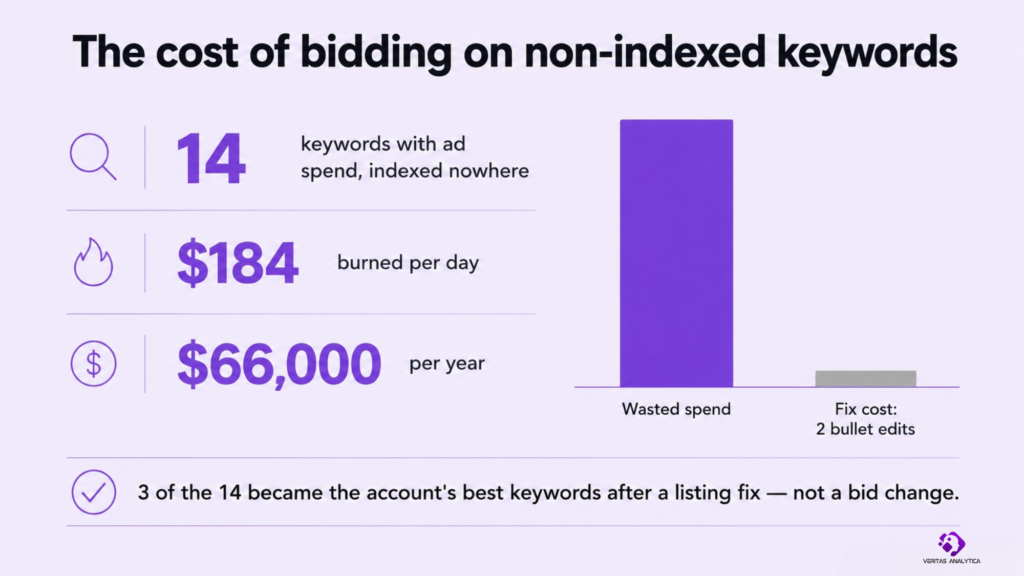
On a stack audit of an 8-figure brand, we found 14 keywords carrying sustained ad spend of $8 to $40 a day each, where the keyword wasn’t indexed in any listing field. Combined, they were burning $184 a day. Call it $5,500 a month, or roughly $66,000 a year.
The brand’s PPC agency had already reviewed these keywords. Their recommendation: low converters, pause them. Reasonable advice if you only look at the ad data. The actual fix was on the listing side. The keywords went into backend search terms and two rewritten bullets, and nothing about the bids changed.
Three of those 14 keywords, once indexed, converted at 2.3 times their old rate and became the highest-ROI keywords in the account. The agency was about to pause the best keywords the brand had, because the only dashboard they were looking at couldn’t see the listing.
How Rufus and COSMO Widen the Indexing Gap
Everything above describes how Amazon worked for years. In 2026 there’s a new layer on top, and it makes the disconnect between your tools harder to see, not easier.
Amazon’s shopping assistant Rufus has now been used by more than 300 million customers, with interactions up more than 210% year over year, and Amazon’s Q4 2025 earnings put its contribution at nearly $12 billion in incremental annualized sales. Underneath it sits COSMO, Amazon’s knowledge graph, which evaluates whether your product actually fits what the shopper means, not just whether your listing contains the words they typed. In Amazon’s own published test on 10% of US search traffic, COSMO lifted purchases by 0.7% and engagement by 8%. And as of this year, sponsored ads appear inside Rufus conversations, which means the ad system and the AI relevance system are now serving the same shopper in the same session.
Here’s why that widens the tool gap. Your index checker gives you a binary answer measured against Amazon’s traditional keyword index: indexed or not indexed. COSMO doesn’t work in binaries. It reads your visible content, your structured attributes, even your reviews, and builds a semantic picture of what your product is for. Backend search terms still handle basic indexing, misspellings and such, but they carry less weight than they used to.
There’s a timing problem too. Traditional keyword changes used to index in about 24 hours. Semantic changes to how Amazon’s AI understands your listing take 7 to 14 days to fully propagate. So even after you fix a listing, your PPC tool spends up to two weeks bidding against a version of your listing that Amazon no longer sees.
Which means your stack now holds three versions of the truth. Your PPC tool has one. Your listing tool has another. Amazon’s AI has a third. And to be fair to the tool makers, this is genuinely hard to solve. Adtomic is bid automation and does that job fine, but it has no awareness of your listing state. Perpetua’s machine learning is sophisticated, but it optimizes toward whatever target ACoS you hand it. No third-party tool today models what Amazon’s AI thinks of your listing while it manages your bids. Not the cheap ones, not the expensive ones.
Why PPC Automation Wastes More Money on Non-Indexed Keywords
If no tool catches the gap, automation doesn’t just miss the problem. It hardwires the wrong answer.
Most rules-based PPC automation runs some version of the same logic: if ACoS is above target, lower the bid; if there are no conversions in X days, pause the keyword. Applied to a non-indexed keyword, that logic permanently “solves” a listing problem with a bid change. The keyword gets bid down or paused, the wasted spend stops showing up as wasted spend, and the underlying listing issue is never found.
The launch phase is where this bites hardest. We’ve seen the pattern repeatedly: a brand launches in August, the agency sets the automation’s target ACoS at 30% because that’s the industry default, and for six weeks the tool dutifully cuts bids on every “high ACoS” keyword. Except launch keywords are supposed to run hot. The product never builds rank. In the cases where the seller intervened, pulled automation off 12 priority keywords and held aggressive bids for 45 days at 55 to 70% ACoS, organic rank reached the top 10 on 8 of the 12 keywords by month three, and blended TACoS settled at 11%.
One number would have prevented the whole mess: break-even ACoS, which is just your pre-advertising margin after returns. A $25 product with $6 COGS and $9 in Amazon fees has a $10 margin, so break-even ACoS is 40%. Any automation target you set without knowing that number is a guess, and the tool will optimize your account toward your guess with perfect discipline.
This, by the way, is why large agencies mostly run PPC manually with bulk files instead of paying percentage-of-spend platform fees across dozens of accounts. We broke down that math in how $30M agencies run Amazon operations on just 5 tools.
The Quarterly Audit That Finds Keywords Not Indexed in Your Amazon Listing
The fix isn’t another subscription. It’s a manual audit that takes about an hour per quarter.
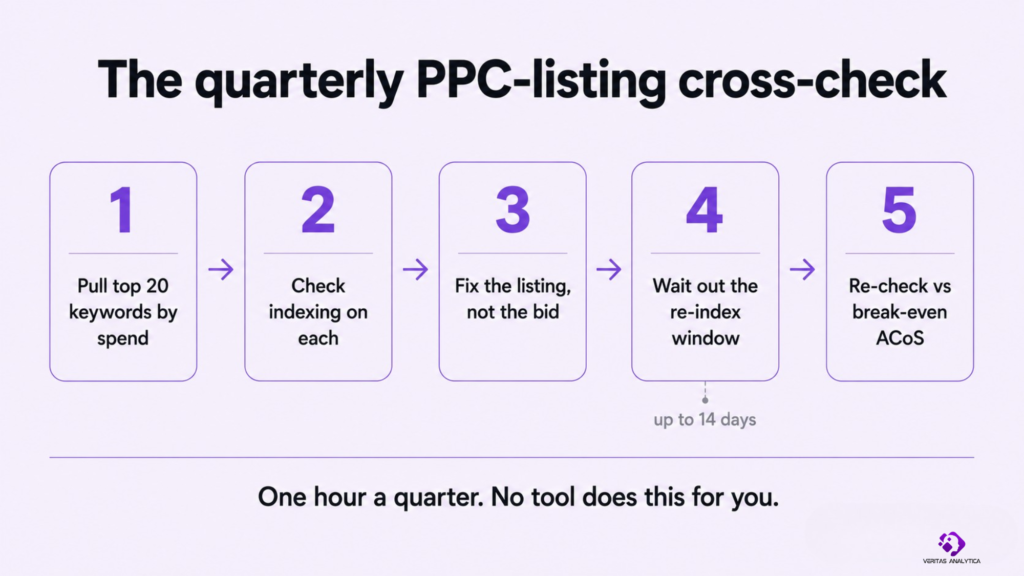
- Pull your top 20 keywords by spend from your PPC tool. Spend, not sales. You’re hunting for money going out.
- Check indexing for each one. Helium 10’s Index Checker works, or search the keyword alongside your ASIN and see if the listing appears. If you’re brand registered, open Search Query Performance in Seller Central alongside this: it’s free, and it shows your impression and purchase share per query, which tells you how badly each non-indexed keyword is underdelivering.
- For any keyword spending money without being indexed, fix the listing first. Backend search terms, a rewritten bullet, wherever the term fits naturally. Do not touch the bid yet.
- Wait out the propagation window. Give traditional indexing a day or two and the semantic layer up to two weeks before you judge the keyword’s performance.
- Then, and only then, re-evaluate the bid against your true break-even ACoS.
Sellers who run this loop have a structural advantage over sellers who trust either dashboard alone. Not because they work harder, but because they’re the only ones looking at both sides of a gap that no tool currently bridges.
The Bottom Line
When your PPC tool and your listing tool disagree, neither one is broken. They were built separately, they store their data separately, and they were never designed to check each other’s work. The disagreement is the architecture.
What’s changed in 2026 is the price of ignoring it. Clicks cost more every year, relevance now sets what you pay as much as your bid does, and Amazon’s AI has added a third opinion about your listing that none of your tools can read. The gap between the ad account and the listing was always where money disappeared. It’s just a wider gap now.
The honest takeaway is that this is still a manual job. An hour a quarter, twenty keywords, one cross-check. Until the tools learn to talk to each other, that hour is the highest-ROI work in your ad account.
For where each tool fits in a properly built stack, start with our complete tool stack guides for private label and wholesale sellers.
Frequently Asked Questions
How do I check if a keyword is indexed on Amazon?
The fastest manual method is to search your ASIN together with the keyword in Amazon’s search bar. If your listing appears, you’re indexed for that term. At scale, Helium 10’s Index Checker will run a keyword list against your ASIN in one pass. Whichever method you use, check your top ad-spend keywords first, since those are the ones where a keyword not indexed in your amazon listing is actively costing you money.
Why is my ACoS high even though my bids look right?
If bid adjustments aren’t moving your ACoS, the problem usually isn’t in the ad account. The most common hidden cause is bidding on keywords your listing isn’t indexed for, which raises your cost per click and lowers your placement at the same time. Check indexing on your high-ACoS keywords before changing another bid. A high ACoS can also be intentional and healthy during a launch, as long as you know your break-even number and you’re buying rank on purpose.
Do backend search terms still matter for Amazon indexing in 2026?
Yes, but less than they used to. The backend field still handles basic indexing, misspellings, and alternate terms. Amazon’s AI systems now put more weight on your visible content: title, bullets, description, and A+ content. Treat backend terms as a supplement, not a strategy. If a keyword matters enough to spend ad budget on, it should appear somewhere a customer can read it.