
Every inventory tool on the market claims it is wholesale-friendly. Most of them were never built for wholesale in the first place. They were built around private label assumptions: one or two suppliers, stable lead times, a small catalog of branded SKUs, and predictable reorder quantities.
Wholesale is a different business. You are managing 20 or more brands, hundreds of SKUs, irregular availability, and minimum order values that the supplier decides, not you. Put a private label tool under that kind of load, and it cracks, usually in ways the landing page never mentions.
This guide gives you a simple 4-question framework to test any wholesale Amazon inventory tool before you pay for it, then scores the four main options against those questions.
Why Private Label Inventory Tools Break Under Wholesale Volume
The problem is rarely a missing feature. On paper, most inventory tools look complete. Reorder alerts, forecasting, purchase orders, and restock suggestions. All the boxes are ticked.
The real issue lies in the underlying workflow’s design. When a tool is built for a seller managing just 15 SKUs and 2 suppliers, it makes some pretty big assumptions: lead times are consistent, each SKU operates independently, reporting is done at the SKU level, and reorder quantities are simply dictated by a formula.
Unfortunately, none of these assumptions really apply in the wholesale world. And when they go wrong, it doesn’t just pop up as an error message. Instead, it manifests as working capital tied up in excess inventory or as countless hours wasted on Excel workarounds that the tool was meant to eliminate in the first place.
So before you compare features, ask these four questions.
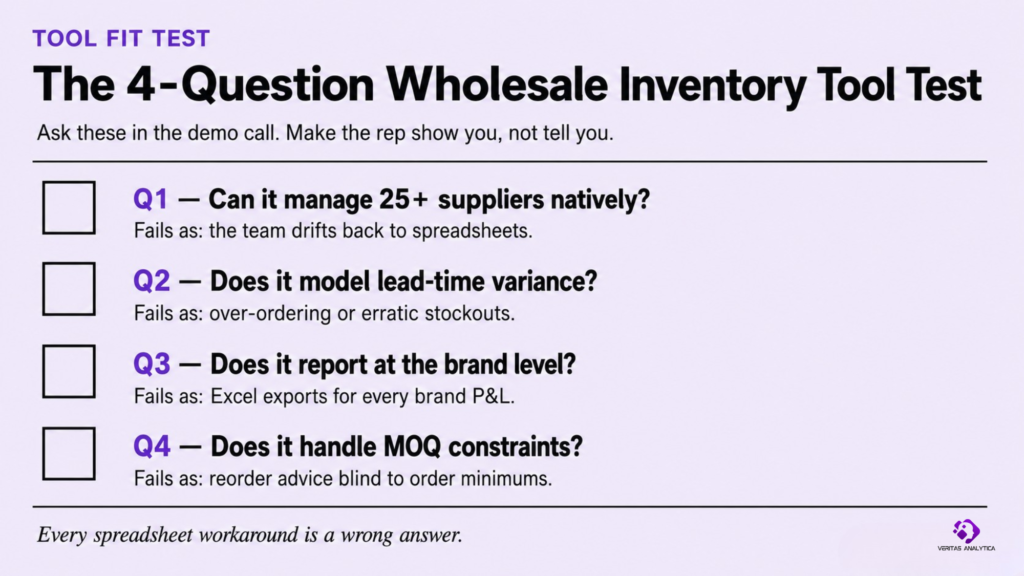
The 4-Question Framework for Evaluating Inventory Tools
Question 1: Can it manage 25 or more suppliers natively?
First private label tools, like InventoryLab, let you track one to three suppliers comfortably. A wholesale operation dealing with 25 brand accounts hits UI friction fast. Supplier records become a chore, purchase orders pile up, and the team drifts back to spreadsheets.
RestockPro and SoStocked handle supplier depth more natively. If supplier management feels like a side feature in the demo, it will feel like a wall at 200 SKUs.
Question 2: Does the model lead to time variance?
This is the question that costs sellers the most money and the one almost nobody asks in a sales call.
When a wholesale brand has a shipping schedule that varies, like three days one month and then 21 days the next, it completely disrupts any reorder point strategy that relies on a consistent lead time. Tools that don’t account for this kind of variability tend to either order too much just to be on the safe side or end up running out of stock unpredictably. Both scenarios can really take a toll on cash flow.
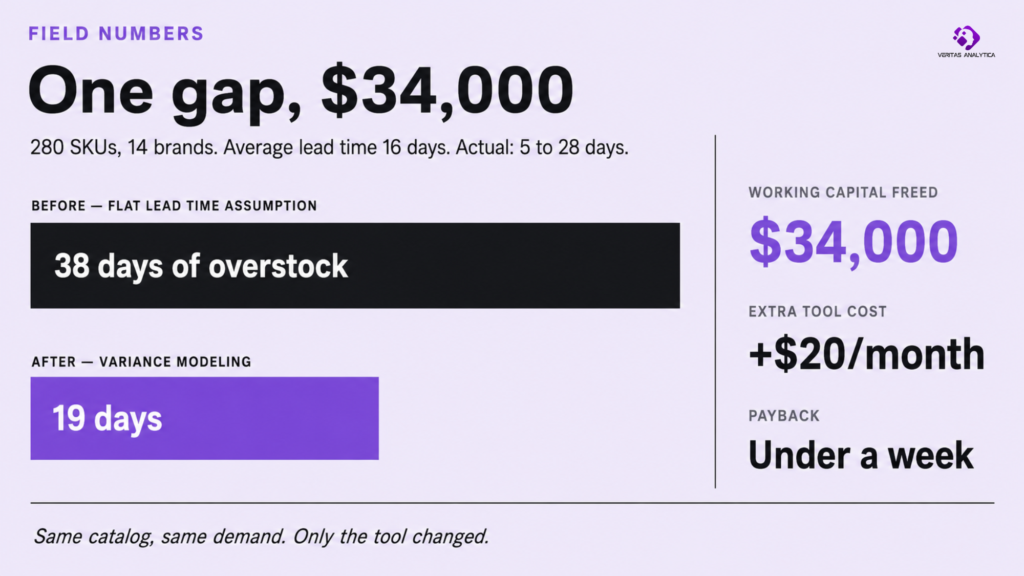
Let’s talk about the impact of fixing this one gap. A wholesale seller managing 280 SKUs across 14 different brands found themselves over-ordering on three brands that had a lot of variability. While their average lead time was 16 days, the actual delivery times were all over the place, ranging from 5 to 28 days. Their previous tool relied on that flat 16-day figure for every reorder, which meant they were sitting on an average of 38 days of excess stock for those brands.
After switching to a tool that accounted for lead time variability, their average overstock dropped to just 19 days. This change freed up about $34,000 in working capital. The new tool did come with an extra cost of $20 a month, but the payback period was less than a week. Migrating tools has its own costs in time and setup, but a gap this expensive usually justifies the move.
Question 3: Does it report at the brand level?
Wholesale margin conversations happen brand by brand, not SKU by SKU. When you sit down to decide whether Brand X still deserves your capital, you need Brand X’s profit on one screen.
Tools that only report at the SKU or category level force you into Excel for every brand P&L conversation. That is not a small annoyance. It means the tool has failed at the exact decision that wholesale sellers make most often.
Question 4: Does it handle MOQ constraints?
Private label sellers reorder in quantities they choose. Wholesale sellers live with constraints like “must order $5,000 from Brand X to keep the account.” Very few tools model minimum order values inside their reorder recommendations.
If the tool tells you to reorder 40 units of one SKU but cannot see that the supplier requires a $5,000 total order, the recommendation is useless. You will end up doing the real math in a spreadsheet anyway.
One extra check while you are at it: bundle and variation handling. Wholesale often means bulk buying variations of the same product. A tool that forecasts each variation as an isolated SKU will misread demand for the product as a whole.
RestockPro vs SoStocked vs InventoryLab vs Helium 10: Scored Against the Framework
Here is how the four main options hold up against the framework, with 2026 pricing.
| Tool | Supplier depth | Lead time variance | Brand reporting | MOQ handling | Price |
|---|---|---|---|---|---|
| RestockPro | Strong | Partial | Partial | Partial | $99 to $300/mo |
| SoStocked | Strong | Strong | Partial | Partial | Order volume based, quoted on demo |
| InventoryLab | Weak past 3 suppliers | No | SKU level focus | No | $49/mo |
| Helium 10 Inventory Management | Basic | No | No | No | Bundled in Platinum, $99/mo on annual billing |
RestockPro: Strongest on Supplier-Level Detail
RestockPro has the strongest supplier and purchase order workflow of the group, and its reorder point logic is sound: daily sales velocity times supplier lead time, plus a safety buffer. The trade-offs are a dated interface and the fact that it is FBA only.
SoStocked: Built for Multi-Brand Wholesale Catalogs
SoStocked is the only one that builds a genuinely custom forecast. It is IPI aware, it models overseas lead times, and it lets you weight seasonality by hand instead of assuming flat demand. That is exactly where simpler tools mistime a Q4 reorder. The catch is pricing: it scales with order volume, and you will not see a number until the demo.
InventoryLab: Better for Accounting Than Scaling
InventoryLab is a solid tool for the seller it was designed for, which is not a wholesale seller. Up to about 3 suppliers, it works fine. Beyond that, every framework question exposes friction.
Helium 10 Inventory Management: Fine as an Add-On, Not a Standalone
Helium 10 Inventory Management only makes sense if you are already paying for Platinum and your catalog is small. As a standalone answer for wholesale, it fails all four questions.
One honest note that applies to every tool on this list: none of them supplies context. No tool knows if a promotion ran last week, or that the listing changed, or that a competitor just sold out and demand is about to spike. They calculate from history. The reorder number is a starting point, not a decision. The judgment layer is still you.
Which Inventory Tool Fits Your Wholesale Stage
For Sellers Under 100 SKUs and 5 Brands
Do not over-buy. InventoryLab or whatever is bundled in your existing suite will carry you, and it is worth checking what your current tools already overlap on before paying for the same feature twice. Spend the savings on inventory.
For Sellers at 100+ SKUs Across 5+ Brands With Variable Lead Times
This is RestockPro or SoStocked territory. Run the four questions in the demo call and make the rep show you, not tell you. If your lead times swing widely, SoStocked’s variance modeling is the deciding factor.
For Multi-Channel, Multi-Warehouse, or Multi-Entity Operations
You have grown past inventory tools. That is an ERP conversation, and it has its own thresholds. See our guide on when an Amazon seller actually needs an ERP. And if you are curious what tooling looks like at the very top end, our breakdown of how $30M agencies run Amazon operations on just 5 tools is the companion read.
Choosing the Right Tool Before You Outgrow It
Here is the truth most tool reviews will not tell you: there is no best wholesale Amazon inventory tool. There is only one tool that matches the way your operation actually works.
The seller in the lead time example did not find a magic tool. They found one that answered a question their old tool could not, and it returned $34,000 to their business. That is what the right fit looks like. It is never about having more features. It is about the four things that quietly decide whether your capital works for you or sits in a warehouse: supplier depth, lead time variance, brand level reporting, and MOQ handling.
So here is your homework, and it takes less than an hour. Open your current tool and run the four questions against it. Be honest about the answers. Every “well, we have a spreadsheet for that” is a workaround, and every workaround is the tool telling you it was built for someone else’s business.
If all four answers hold up, you are in better shape than most wholesale sellers. If they do not, you now know exactly what to ask in your next demo call, and you will spot the right tool in ten minutes instead of finding out the expensive way.
Inventory is one layer of the stack. For what to use at every stage, from product research to accounting, our wholesale tool stack guide is the next read.
Frequently Asked Questions
What is the best inventory management tool for Amazon wholesale sellers?
There is no single best tool, and anyone who names one without asking about your operation is guessing. For wholesale sellers running 100 or more SKUs across 5 or more brands, RestockPro and SoStocked are the two serious options, and the choice between them usually comes down to lead time variance. If your suppliers deliver on unpredictable schedules, SoStocked’s custom forecasting is the deciding factor. Under 100 SKUs, InventoryLab or whatever is bundled in your existing suite is usually enoug
Is Helium 10 good for wholesale inventory management?
Not as a standalone answer. Helium 10’s Inventory Management is a basic feature bundled into the Platinum plan, and it was built with private label catalogs in mind. It does not handle deep supplier lists, lead time variance, brand level reporting, or MOQ constraints. If you already pay for Platinum and run a small catalog, it can hold you over. A wholesale operation at scale will outgrow it quickly.
How much do Amazon inventory management tools cost in 2026?
Entry level tools like InventoryLab start around $49 a month. RestockPro runs $99 to $300 a month depending on order volume. SoStocked prices on order volume and only quotes on a demo call. Helium 10’s inventory feature is bundled into Platinum at $99 a month on annual billing. The real cost question is not the subscription, though. A tool with the wrong assumptions can tie up tens of thousands in overstock, which makes the monthly fee the smallest number involved.