
Some sellers are running systems built for $50M operations while doing $3M in revenue.
They were told the same thing every growing seller gets told: “as you scale, you’ll need an ERP.” So at $2M or $3M, they sign up for a platform that costs more per month than their first hire, spend three months setting it up, and end up using only a small part of what they pay for.
Most Amazon sellers will never need a full ERP. They use a few of its features and pay for all of them. The trick is knowing where the line sits, and what to run until you cross it. This guide lays out the five complexity thresholds that make an Amazon seller ERP worth it, what each of the major systems costs in 2026, and the lightweight stack that does most of the same jobs for far less.
What an ERP actually is (and what sellers think it is)
An ERP (enterprise resource planning) is one system that runs inventory, orders, purchasing, accounting, and sometimes CRM, all sharing one database. The pitch is a single source of truth: one place where a sale updates stock, records revenue, and triggers a reorder, with no exporting or re-typing.
The main players in the Amazon and multichannel space are Cin7, Linnworks, Brightpearl, Sellercloud, and NetSuite at the top end. It’s important to clarify something right away, because outdated tool lists are everywhere: SkuVault is no longer a separate product. Linnworks bought it, and it now ships as SkuVault Core inside the Linnworks platform. If a comparison still lists them as two competing ERPs, it hasn’t been updated.
Here’s what these companies push hardest: the idea that more is better. More modules, more setup options, more “scalability.” But a feature you don’t use isn’t an asset. It’s a cost you pay every month and work around every day.
The 5 complexity thresholds that justify an ERP
An ERP earns its cost when you have real complexity across at least three of these five dimensions. Not one. Not “I might someday.” Three, today.
- Multi-channel. You sell across Amazon, Walmart, Shopify, wholesale, and maybe physical retail, and stock has to stay accurate across all of them in real time.
- Multi-warehouse. Three or more fulfillment locations that need one shared view of stock, including a mix of FBA, SFP, and 3PL.
- Multi-company or multi-currency. Separate legal companies in, say, the US, UK, and EU that need combined accounting and more than one currency.
- Complex builds from parts. Products you manufacture or assemble, where you track parts, build kits, or run production batches.
- Advanced accounting. Accounting with several people, approval steps, purchase-order sign-off, and cost tracking by project.
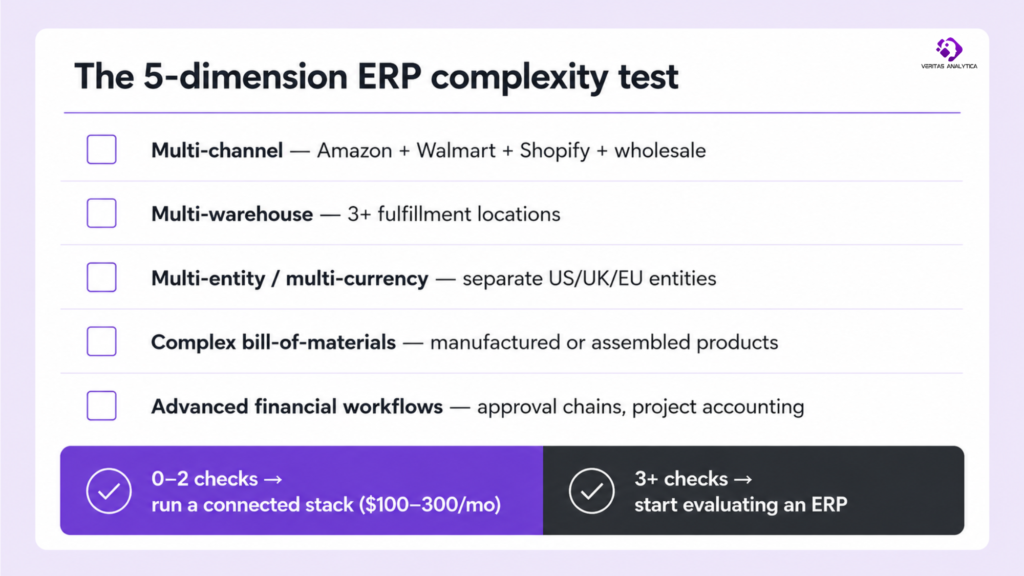
Most sellers making under $5 million in revenue typically have either none or just one of these elements. A few might manage to have two, but it’s rare to find anyone with three. For instance, a private-label brand on Amazon US that uses a 3PL and has a bookkeeper usually operates with just one channel and one company. On the other hand, a wholesale seller at a similar revenue level might handle a lot more SKUs and suppliers, yet still be limited to one channel and one company. In either case, this isn’t really an ERP issue; it’s more about having a connected stack, which is a lot easier and cheaper to fix. Which dimension you trip first really depends on your business model, and we’ll dive deeper into that later
What to run instead under $5M
Here’s a stack that does most of what an ERP does for a single-channel seller, at a small fraction of the cost. Every price below is verified for 2026.
- Profit and inventory analytics: Sellerboard: $19 to $79/mo depending on order volume. Live, ASIN-level profit and loss, plus restock alerts.
- Bookkeeping ledger: QuickBooks Online ($38 to $275/mo) or Xero (roughly $29 to $80/mo for the US Early to Established tiers).
- Settlement reconciliation: A2X: from $29/mo, rising with order volume. This is the most important piece. Amazon doesn’t pay you per order. It pays one lump sum every 14 days, after taking out FBA fees, referral fees, storage, refunds, ad spend, and tax. QuickBooks and Xero can’t break that deposit apart. They drop the whole payout into a single income line. A2X splits it into revenue, fees, refunds, and cost of goods, then posts a clean entry so your books match the bank to the penny. Add it once you pass about $50K/month in Amazon sales. Below that, doing the math by hand is still cheaper than the subscription.
- Purchase orders: a well-built Google Sheet plus a simple email process. Free, and more flexible than most PO modules until you need real approval steps.
- Supplier management: Notion or Airtable: $0 to $20/mo.
Total: roughly $100 to $300/mo, all in.
Here’s something worth noting: Veeqo, the handy multichannel inventory and shipping tool, is now available for free to Amazon sellers after being acquired by Amazon. If you’re selling on just one marketplace and primarily need help with shipping and syncing your stock, this could simplify things for you by eliminating one expense.
However, there’s a catch. The downside of this setup is that it doesn’t automatically integrate everything for you. Each tool operates independently, and someone still has to connect the dots. This works well if you’re managing just one channel and one company, but it can become a hassle once you start scaling up, which we’ll discuss further
What a real ERP costs in 2026 (Brightpearl vs Linnworks vs Cin7)
This is where the price shock hits, and where pricing has gotten harder to see, not easier.
| System | Published 2026 price | Notes |
|---|---|---|
| Cin7 Core | $349 / $599 / $999 per month (Standard / Pro / Advanced) | The only one of the three with public, tiered pricing. Omni is priced by quote (~$1,000–3,000+/mo). |
| Linnworks | By quote; ~$200–449/mo reported as a starting point | Pricing is no longer published; tied to order volume, with add-ons billed separately. |
| Brightpearl | Unpublished; ~$1,000–3,000+/mo reported | The pricing page is a “request a demo” wall since the Sage acquisition. Reviewer reports put setup at $10,000 to $50,000 on top. |
Two things to take from that table. First, when a vendor hides its price behind a sales call, it controls the negotiation from the start. That’s the plan, not an accident. Second, the subscription is the floor, not the ceiling.
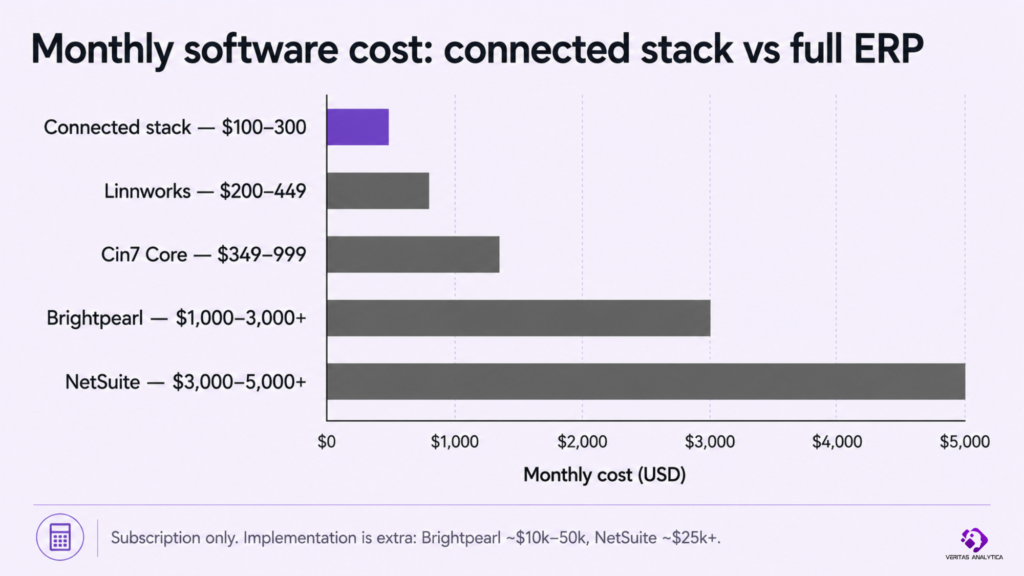
What sits under the prices matters more than the headline numbers. Cin7 Core’s tiers come with firm annual order caps: about 6,000 orders on Standard, 24,000 on Pro, and 120,000 on Advanced. The features sellers actually buy an ERP for sit behind the higher tiers. Built-in manufacturing (MRP) starts at the $599 Pro tier, and advanced warehouse management only opens up at $599 and above. Hit your order cap partway through the quarter and you’re pushed up a tier. Brightpearl’s real cost is the setup, not the license. Getting it running usually takes 8 to 16 weeks with its team, and reviewers report first-year totals well above the sticker price once setup, data migration, and training are counted. For all three, renewal prices that jump above the original quote are a common complaint in G2 and Capterra reviews.
The model also changes which of the three fits. Cin7’s manufacturing module is a maker feature, so it suits private-label brands that build products, not resellers. Linnworks, with SkuVault for warehouse management, is built for high-SKU, high-order multichannel operations, which fits wholesale and arbitrage. Brightpearl leans toward wholesale and retail, with strong purchase-order, supplier, and accounting handling. So ‘which ERP’ often has a different answer by model before price even enters.
So the real comparison isn’t “$200/mo stack vs $349/mo ERP.” It’s “$200/mo stack vs $349 to $1,000/mo, plus per-user fees, plus setup hours, plus the tech time to make it all work.” For a seller who would use a third of the features, that math rarely adds up.
Where the lightweight stack actually breaks
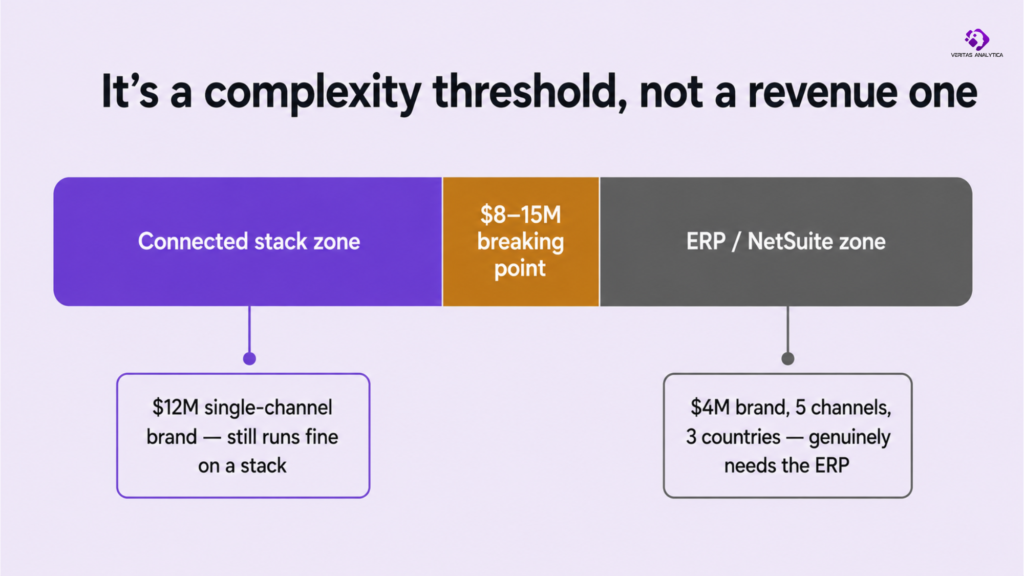
For a private-label brand that operates on a single channel, this often happens when revenue hits between $8 million and $15 million. On the other hand, for wholesale sellers, this complexity can arise much sooner, sometimes around $3 million to $5 million, since the focus is more on SKU and order volume rather than just revenue. We’ll dive deeper into that distinction shortly.
This is where an ERP really justifies its cost, and it’s important to acknowledge that. With a single database, a sale automatically reduces stock, records revenue, and updates the reorder point all in one go. No need for exports or the hassle of fixing tools that don’t sync up. For a brand that assembles products from various parts, or one that needs to merge the financials of three companies into a single profit and loss statement, that’s not just an expense, it’s essential. That’s the core function. Once you hit around $10M and have multiple companies to juggle, most brands turn to NetSuite to streamline their financials and keep a close eye on inventory value. But that’s a whole different discussion, as NetSuite starts at about $999 a month for the basic platform, plus an additional $99 to $199 per user, and a setup cost of $25,000 or more. That kind of investment only makes sense when the complexity is significant.
That’s the crux of ERP systems. It’s all about complexity, not just revenue. A $12M single-channel private-label brand can still thrive with a connected stack. However, a $4M brand operating across five channels in three different countries might genuinely require an ERP. Revenue figures are just a rough indicator; the real test lies in the five dimensions of complexity.
Wholesale vs private label: same test, different triggers
The five dimensions apply to every seller, but the two main models trip different ones, at different points. This matters, because a guide that treats all sellers the same will point you at the wrong threshold.
Private label is usually pushed toward an ERP by product and channel complexity. The trigger that’s almost unique to PL is building products from parts: kits, bundles, multipacks, or assembly, which is the dimension Cin7 charges extra for (its manufacturing module starts at the $599 Pro tier). The others are adding channels like Shopify or Walmart on top of Amazon, and expanding into the UK or EU, which brings in multiple companies and currencies. PL brands often run a handful of SKUs at higher volume each, so they stay stack-friendly for longer.
Wholesale and arbitrage get pushed by transaction and catalog volume instead. Hundreds or thousands of SKUs, not dozens. Dozens of suppliers and hundreds of purchase orders a month, with landed cost tracked per supplier. High order throughput, often across more than one prep center or 3PL. Wholesale rarely touches manufacturing or multiple currencies, but it blows past the volume-driven limits much sooner.
This is why the same revenue gives opposite answers. A $3M PL brand with 15 SKUs, three suppliers, and one channel is nowhere near an ERP. A $3M wholesale seller with 800 SKUs, 40 suppliers, and hundreds of POs a month is already straining a spreadsheet stack. The order caps make it concrete: a high-volume wholesale seller can hit Cin7’s 6,000-order Standard cap on count alone, while a private-label brand at the same revenue sits well below it. Count the dimensions your model actually trips, not the ones a generic guide lists.
A common trap: buying an ERP too early
Here’s a pattern that shows up often enough to be worth describing. It’s not just one seller’s experience; it’s a story that keeps repeating itself.
A seller passes $2M and feels pressure to “level up.” They buy a top-tier ERP at four figures a month. Six months in, they’re using only a small share of the features. Setup has eaten well over a hundred hours of the team’s time. The platform works fine. It just solves problems they don’t have, while the problem they do have (knowing true profit per product for a brand, or true landed cost per supplier for a reseller) was handled better by the $39 tool they cancelled.
Switching back to a more connected stack takes a few weeks, but it ends up saving them five figures a year in software costs alone, not to mention all the hours the team wasted on a system they barely utilized.
The ERP wasn’t a bad tool. It was a bad fit for their level of complexity. Those are two different problems, and only one of them is the vendor’s fault.
So, do you need an Amazon seller ERP?
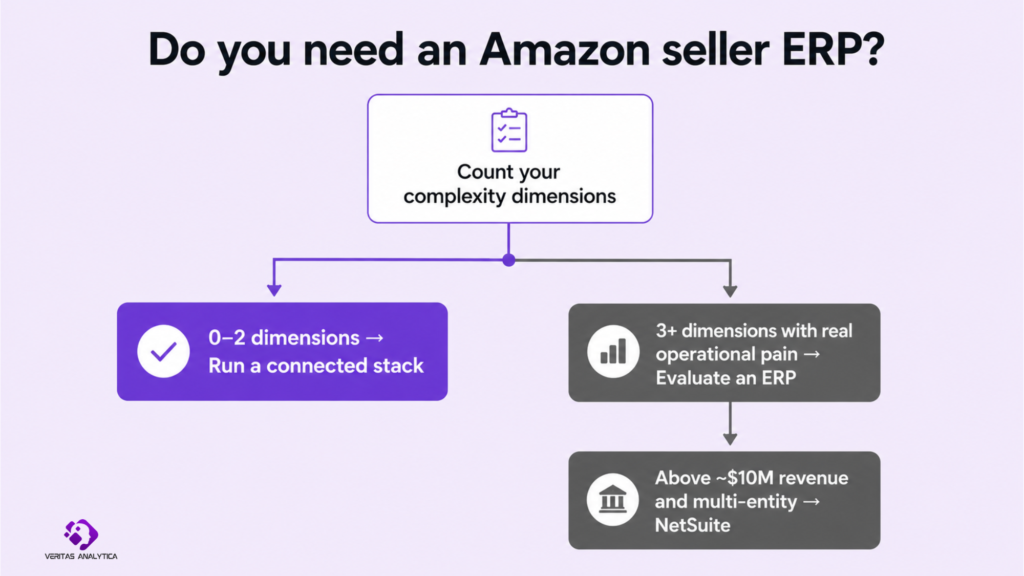
Count your complexity dimensions honestly: Are you dealing with multi-channel, multi-warehouse, multi-company setups, intricate builds from parts, and advanced accounting? If you find yourself with:
- Zero to two dimensions: you don’t need an ERP. A connected stack at $100 to $300/mo will beat one. It’s cheaper, faster to change, and easier to undo if you outgrow a piece.
In case of:
- Three or more dimensions, with real day-to-day challenges: it’s time to start exploring your options. Look for the one that openly shares its pricing so you can make genuine comparisons, and be sure to test it against your actual order volume instead of just relying on a sales demo.
Don’t buy an ERP just because you’re growing. Growth on its own isn’t complexity. Buy one when you’ve hit clear limits a connected stack can’t handle, and not a quarter sooner.
Frequently Asked Questions
Do I need an ERP for Amazon FBA?
Most FBA sellers don’t. If you sell on one or two channels from a single company, a connected stack of profit analytics, a bookkeeping ledger, and a settlement reconciliation tool covers the same ground for $100 to $300/mo. An ERP becomes worth it when you have real complexity across at least three dimensions: multiple channels, multiple warehouses, multiple companies, complex manufacturing, or advanced accounting.
What’s the difference between an ERP and inventory software?
Inventory software manages stock and reorders. An ERP brings inventory, orders, purchasing, and accounting into one shared database, so a sale updates every part at once. Inventory tools are cheaper and do less. ERPs do more and cost far more, and most of that extra range goes unused until you have real multichannel complexity.
Is Linnworks an ERP?
Linnworks is a multichannel order and inventory management platform that now includes SkuVault for warehouse management. It covers much of what sellers want from an ERP on the operations side, but it isn’t a full accounting and finance system on its own. Pricing is by quote in 2026.
What revenue do you need before getting an ERP?
There’s no clean revenue number, and treating it like one is how sellers buy too early. An ERP tracks complexity, not sales. A $12M single-channel private-label brand can run comfortably on a connected stack, while a $4M brand selling across five channels in three countries may really need one. Model matters too: a wholesale seller usually reaches the line earlier than a private-label brand at the same revenue, because SKU count, supplier count, and order volume drive the complexity. Count your complexity dimensions: channels, warehouses, companies, products built from parts, and accounting needs. Not your revenue.
How much does an Amazon seller ERP cost?
Cin7 Core publishes tiers at $349, $599, and $999/mo. Linnworks and Brightpearl no longer publish pricing; reported figures run from roughly $200/mo for Linnworks to $1,000–3,000+/mo for Brightpearl, with setup often adding $10,000 to $50,000. NetSuite, at the top end, runs about $999/mo base plus $99 to $199 per user and $25,000 or more to set up. Budget for the setup and add-ons, not just the subscription.